


You can play perfectly good golf with the wrong bag, but you will notice it by the third hole, the first cart ride, or the walk back to your trunk. A bag that fights your routine gets heavy fast, wastes storage space, and makes club access more annoying than it should be. This golf bag guide is built to help you choose between stand, cart, hybrid, and Sunday bags based on how you actually play, not just what looks good online. Expect to spend about 15 minutes working through this process. Difficulty level: Beginner. If you want a wider gear picture beyond bags, our Best Golf Accessories for Men article is a useful next stop.
Quick overview
- Identify whether you mostly walk, ride, travel, or practice.
- Choose between stand, cart, hybrid, and Sunday bag formats.
- Check carry weight, club divider setup, pockets, and strap comfort.
- Decide how much premium material and structure you actually need.
- Compare long-term convenience against price and maintenance.
- Buy the bag that fits your most common round, not your occasional one.
What you'll need
- Your honest playing habits for the last 10 to 20 rounds
- A rough budget range
- A list of whether you usually walk, use a push cart, or ride
- Your typical club count and how much gear you carry
- Awareness of whether premium materials, such as leather, matter to you aesthetically and practically
Choose by use case first, not by appearance
Step 1: Audit how you usually play
Start with one question: what does a normal round look like for you? Not the once-a-year buddies trip. Not the dream club you hope to join. Your normal week matters more than your aspirational one.
If you walk most rounds, a lighter stand or hybrid bag usually makes more sense than a full cart design. If you ride almost every time, cart stability and storage may matter more than carry comfort. If you play quick evening nines or range sessions, a Sunday bag could be the cleaner answer.
- Mostly walk 9 or 18: prioritize low weight and comfortable straps
- Mostly ride: prioritize pocket access and cart stability
- Mix walking and riding: prioritize hybrid versatility
- Practice, par-3, or short rounds: prioritize simplicity and compact size
Match the bag family to your routine
Step 2: Match your round style to a bag type
This is where most buying decisions become clear. The best golf bag is often the one built around your most common transport method.
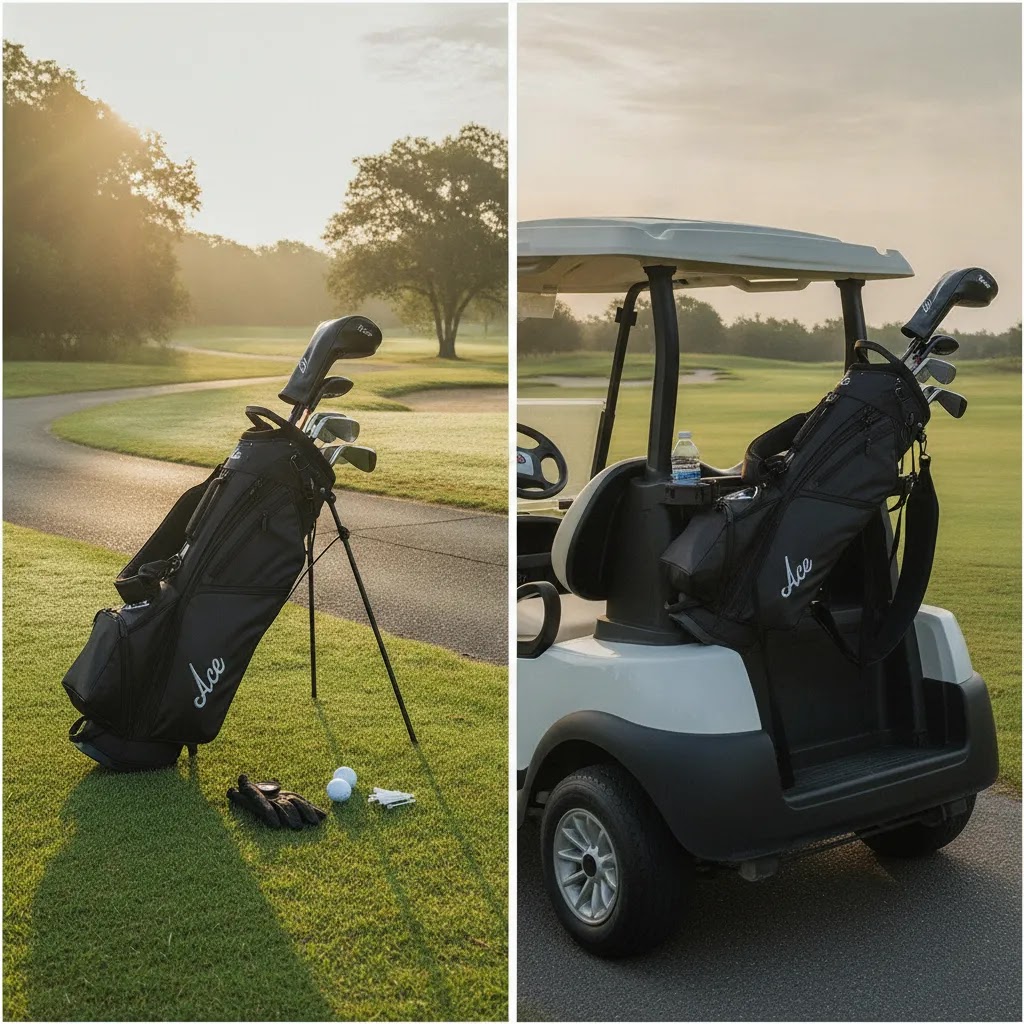
Stand bags are usually the best fit for golfers who carry. They tend to balance lower weight, usable storage, and easier movement around the course. Ace of Clubs offers a ready-made Ace of Clubs Leather Stand Golf Bag at $500 with stand legs, a dual strap, a 5-way divider, rain hood, and cart strap sleeve.
Cart bags suit players who ride or use push carts often. They usually offer more pockets, more structure, and less twisting once strapped in place. Ace of Clubs also makes a Custom Leather Cart Golf Bag at $1000 with a 14-way divider, insulated pocket, plush valuables pocket, garment compartments, and canvas rain hood.
Hybrid bags sit in the middle. They try to carry reasonably well while still behaving better on a cart than many lightweight stand bags. If your play pattern is truly mixed, hybrid can be the safest answer.
Sunday bags are the minimalist option. They are best for range work, half sets, travel flexibility, or fast casual rounds, but they may feel limiting if you carry a full setup and extra layers.
Check the details that affect every round

Step 3: Check weight, divider layout, and storage
Once you know the bag type, move to the parts that change daily usability. Weight is the obvious one, but it is not the only one. Club organization and pocket layout matter just as much after a few rounds.
If you carry, every extra pound counts more than you think. If you ride, weight matters less, but top access and pocket positioning matter more. A 14-way divider may sound ideal, yet some players prefer fewer dividers because full-length separation can add bulk and stiffness.
- For walkers: focus on overall weight, dual straps, and balance
- For riders: focus on forward-facing pockets and stable base shape
- For gear-heavy players: look for apparel, valuables, and insulated pockets
- For cleaner setups: fewer dividers may feel less cluttered and easier to manage
If a lighter setup is a priority, see our guide to Lightweight Golf Bags for a narrower decision path.
Feature details competitors focus on (coolers, travel readiness, and hardware)
Once weight, dividers, and basic storage are covered, small features start to matter because you touch them every round. Many bag reviews spend disproportionate time here for a reason: it is where a bag either supports your routine or quietly creates friction.
Cooler and insulated pockets: what “insulated” usually means
Most “insulated” golf bag pockets are designed to slow temperature change, not keep drinks cold all day. In practice, they typically help for a few hours, especially if you start with cold cans and add a small ice pack. If you play in high heat, walk long rounds, or like to keep snacks from getting warm, an insulated pocket can be genuinely useful. If you mainly play early mornings or quick nines, it may not matter much.
- Drainage: an insulated pocket is more useful if it can handle condensation or melting ice. Look for a drain grommet or an interior that will not trap water.
- Zipper access on a cart: a cooler pocket is frustrating if the cart strap blocks the zipper pull or forces you to reach behind the bag.
- Capacity expectations: many cooler pockets fit 2 to 4 cans plus a small snack. If you expect 6 cans and ice, you will likely be disappointed unless the pocket is clearly oversized.
Travel-ready details that change real use
Even if you do not fly often, travel-friendly construction usually improves daily durability. The details below tend to separate a bag that ages well from one that starts to feel tired after a season of cart straps, trunk loading, and wet rounds.
- Reinforced handles in more than one location so you can lift the bag cleanly from a trunk, cart basket, or travel cover
- Zipper durability, including smooth pulls, tight stitching at the zipper ends, and no exposed areas that snag easily
- Rain hood storage that is easy to access, since a rain hood that lives buried under apparel rarely gets used when you actually need it
- Towel ring and glove patch placement that does not interfere with your lead hand while carrying or with cart strap routing
- Umbrella sleeve sizing and placement that does not block club insertion or rub your shafts when you walk
Sanity-check pocket access once the bag is strapped in
Pocket layouts can look perfect online, then become awkward once the bag is secured to a riding cart or push cart. Before you commit, mentally simulate how you reach for the items you use most, especially on the tee and between shots.
- Can you open the rangefinder pocket with one hand without fighting the strap?
- Does the valuables pocket open toward you, or does it dump toward the ground if the bag is angled?
- Can you reach balls, tees, sunscreen, and a glove without unstrapping the bag?
- Does the umbrella sleeve or towel ring block any frequently used pocket zippers?
- Does the cooler pocket sit where it stays accessible, even if the cart has a lower strap position than you expect?
Decide how much material quality really matters
Step 4: Review materials, durability, and weather needs
Bag materials change both feel and ownership experience. Nylon and synthetic bags often win on low maintenance and lower weight. Leather or premium tour-grade builds can offer a richer look, more structure, and a more elevated finish, but they may weigh more and require more care depending on climate and storage habits.
Ace of Clubs leans into premium construction. Its Custom Leather Stand Golf Bag costs $1000 and includes tour-grade leather, a 6-way divider, stand legs, insulated pocket, plush-lined valuables pocket, canvas rain hood, and custom embroidery. That is a different value proposition from an entry-level synthetic carry bag.
If premium materials are part of your shortlist, the broader topic is covered in our Leather Golf Bags article. If style and finish are especially important, the Luxury Golf category is also worth browsing.
How to evaluate brand quality and build without hype
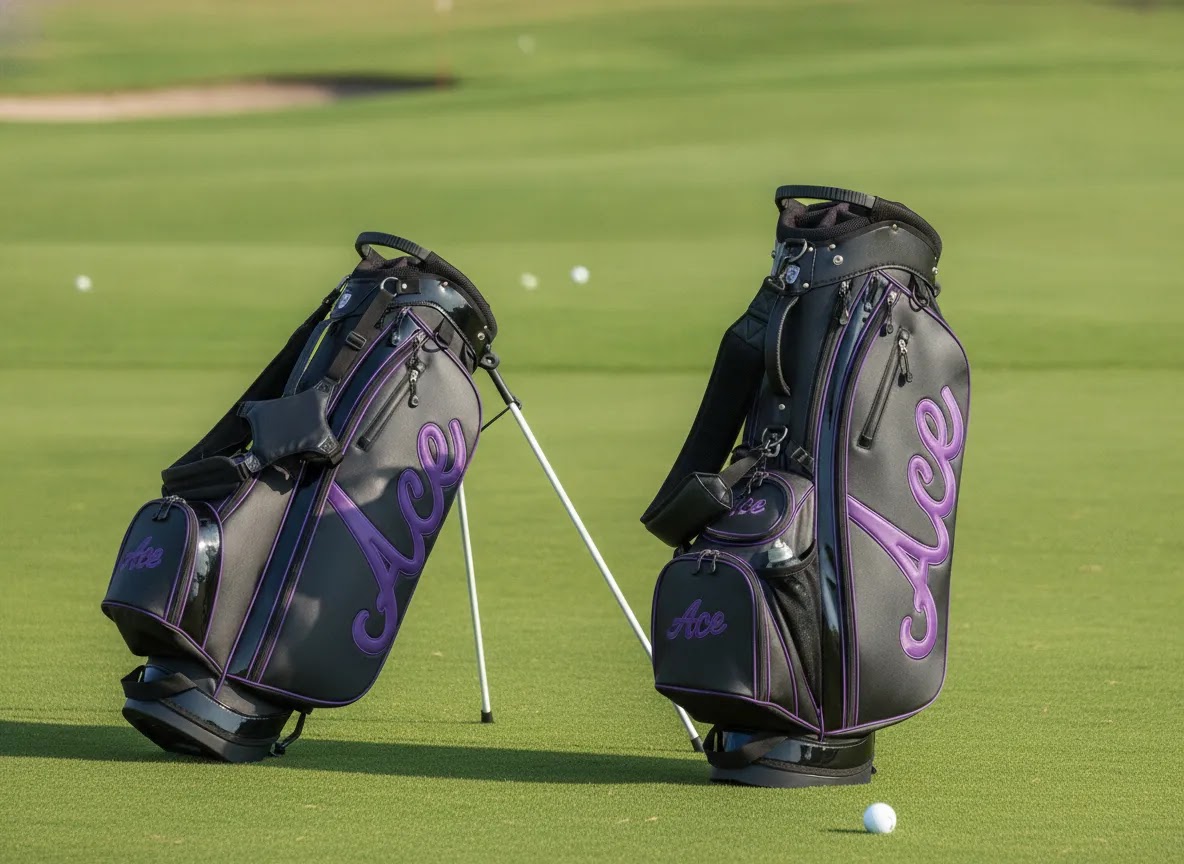
Brand reputation can be a useful signal, but it is not a substitute for checking build quality directly. Two bags can look similar in photos and differ significantly in how they hold up to cart straps, repeated lifting, and wet rounds. A quick “quality audit” helps you compare options more objectively, especially across different price points.
A simple quality audit you can do quickly
- Stitching and reinforcement: look for consistent stitch length, clean corners, and reinforcement at high-stress zones like handle bases, pocket corners, and strap anchors.
- Seam binding and edges: clean binding and protected edges reduce fraying over time, particularly on pocket openings and along the top cuff.
- Base rigidity and stability: a stable base matters on carts and on uneven tee boxes. A base that flexes too easily can lead to twisting and premature wear.
- Stand mechanism tolerance: on stand and hybrid bags, check whether the legs deploy smoothly and retract cleanly. Excess wobble can become annoying and can also stress attachment points.
- Zipper track quality: zippers should run smoothly without snagging and should not feel like they are separating under light tension. Zippers also take the most abuse in cold weather and when the bag is overstuffed.
- Strap attachment points: straps and their anchors see constant load. If an anchor looks thin, loosely stitched, or overly flexible, it may not age well if you carry often.
Warranty, repairability, and replacement parts as a value lever
Long-term value is not only about the initial build. It is also about what happens when something wears out. Rain hoods get lost, straps wear, stand legs can get bent, and zipper pulls can break. A bag with clear warranty coverage and a path to replacement parts may offer better ownership economics than a slightly cheaper bag that is effectively disposable after one failure.
Before buying, look for whether the brand supports common replacement items like rain hoods, straps, and stand components, and whether warranty terms are clear about what is covered versus normal wear. If you play frequently, those details can matter as much as pocket count.
A decision rule for “best luxury golf bags” vs “best value bags”
You do not need a label like “luxury” or “value” to decide where you fit. Use your routine to decide which side of the trade-off you should prioritize.
- If you play often, care about finish, and want the bag to feel structured and refined for years, premium construction and materials may be worth paying for, even if it adds weight and requires a bit more care.
- If you walk a lot, play in varied weather, or want minimal maintenance, a lighter, simpler build often delivers better day-to-day practicality, even if it has fewer premium touches.
- If you are split, prioritize the parts you cannot fix later: carry comfort, strap anchors, base stability, and zipper quality. Pocket layout can be adapted, but a bag that carries poorly stays that way.
Compare real trade-offs, not marketing claims
Step 5: Compare premium and value trade-offs
A more expensive bag is not automatically better for your game. It may be better built, more customizable, or more visually distinctive, but that only matters if those benefits match how you play.
For example, the Ace of Clubs stand bag at $500 may appeal to players who want a premium ready-made bag with stand functionality and cart compatibility. The custom cart bag at $1000 makes more sense if you value a 14-way top, larger storage plan, and custom branding. The custom tour staff bag at Custom Tour Staff Bag pricing of $1100 is best reserved for golfers who truly want full staff-bag size, more compartments, and statement-level presence.
The trade-off is simple:
- Less expensive bags often reduce material richness, customization, or storage structure
- More expensive bags may add durability, craftsmanship, and premium finish, but also bulk and maintenance
- Custom bags may improve fit and identity, but can involve longer production lead times
Make the final decision around your most common round


Step 6: Make the final pick with confidence
If you are stuck between two bag types, buy for the round you play most often. That single filter usually solves the indecision. A golfer who walks 70 percent of the time should not buy a bulky cart bag just because it has more pockets. A rider who brings rain gear, snacks, and extras should not force a tiny carry bag just because it looks sleek.
For many golfers, the practical shortlist looks like this:
- Stand bag if you walk often and still want full-round capability
- Cart bag if you ride often and want maximum organization
- Hybrid bag if your routine is evenly split
- Sunday bag if your rounds are shorter, lighter, or more practice-focused
If you are shopping for a more tailored fit or specific design perspective, our Women's Golf Bags article may help narrow fit and style priorities as well.
Ace of Clubs options worth comparing
Ace of Clubs is one useful place to evaluate premium bag options if you care about materials, customization, and a more polished look than standard off-the-rack designs. The current lineup includes a ready-made leather stand bag at $500, a custom leather stand bag at $1000, a custom leather cart golf bag at $1000, and a custom tour staff bag at $1100. Those options cover the main needs most serious buyers compare: walking comfort, cart organization, premium construction, and higher-end personalization.
For broader shopping context, you can also browse the main Golf Accessories hub. That gives you a wider view of related gear categories if your bag decision is part of a larger setup refresh.
Pros and Cons

Strengths
- Choosing by bag type first makes the buying decision faster and more accurate.
- Stand, cart, hybrid, and Sunday bags each solve a distinct on-course problem.
- Premium options from Ace of Clubs cover both ready-made and custom routes.
- Features like divider count, strap design, and pocket layout have clear day-to-day impact.
- Buying for your most common round reduces the risk of overbuying or underbuying.
Considerations
- Premium leather and tour-grade bags may cost substantially more than basic synthetic models.
- Heavier or more structured bags may feel less practical for golfers who carry often.
- Custom bags may involve longer lead times and require more careful specification before ordering.
- Minimalist Sunday bags can become frustrating if you later want full storage and full-set convenience.
Common mistakes to avoid
- Buying for looks alone. A beautiful bag that does not fit your play style becomes a chore quickly.
- Overvaluing pocket count. More storage only helps if you actually carry that gear.
- Ignoring carry comfort. Strap design and weight distribution matter more than many buyers expect.
- Buying for the rare round. Your usual 18 should decide the bag, not your occasional travel week.
- Assuming premium always means better. Premium materials may improve finish and durability, but they may not be the best fit for every golfer.
Golf travel and airline handling: pack smart and reduce break risk
Airline handling is hard on golf clubs and golf bags. Even with a quality travel cover, impacts, compression, and awkward drops can happen. The goal is not perfection. It is reducing the most common failure points so you are less likely to arrive with a snapped shaft or a damaged head.
Flying with clubs: what to remove, what to protect, and what typically breaks
Drivers and fairway woods tend to be the most vulnerable because of head mass and shaft length. One common precaution is removing the adjustable driver head (and sometimes fairway heads) and packing the head separately inside the travel cover. That can reduce leverage on the shaft during impact. It is not required in every situation, but it is a reasonable risk-reduction step if you are flying, especially if your travel cover is soft-sided.
- Protect shafts by filling empty space so clubs cannot rattle. Towels, extra clothing, or purpose-built support sticks are common solutions.
- Reduce movement at the top of the bag. Most damage happens when the clubheads can swing and then stop suddenly.
- Expect pressure points at the top cuff and around stand mechanisms. That is where impacts often concentrate.
- Check that any removable parts are secured. Loose adjustment wrenches, ball markers, or batteries can become damaging projectiles inside a travel cover.
There is always some risk when flying with golf equipment. Soft travel covers can be convenient and lighter, but they typically require more careful internal packing. Hard cases generally add protection but can be heavier and more cumbersome to transport.
Stand bag vs cart bag vs staff bag inside a travel cover
Bag shape affects how easy it is to protect your clubs in transit. Stand bags often have protruding legs and hinges, which can create pressure points in a travel cover. Cart bags tend to have a more uniform shape that can pack neatly, but their larger pockets and structure can make the fit tight depending on the cover. Staff bags are larger and heavier, which can be harder to maneuver and may push you closer to airline weight limits.
- Stand bags: pay extra attention to leg hinges and the stand base area so they do not catch or press into the cover.
- Cart bags: focus on preventing clubhead movement since the bag often sits tall and stable inside the cover.
- Staff bags: confirm your travel cover sizing and consider total packed weight before you leave for the airport.
Airline policy and a practical pre-flight checklist
Airline rules and liability limits vary by carrier and fare type, and they can change. It is smart to check your airline’s current sports equipment policy before every trip, including size, weight, and any special handling guidance. Some carriers may limit coverage for damage if clubs are not packed in an approved manner.
- Take photos of your clubs and bag before you pack, including close-ups of woods and any existing marks.
- Make a quick inventory list, especially if you carry premium shafts or a full set.
- Add ID tags on the travel cover and inside the cover in case the exterior tag is torn off.
- Pack any removable heads, tools, and valuables in a way that cannot shift.
- After landing, inspect the bag and key clubs before leaving the airport so you can report issues quickly if needed.
What to do next
If you have narrowed the field to a carry-friendly setup, start with lightweight and stand-focused options. If you know premium materials are the main appeal, compare leather-focused builds next. If you are buying with fit, style, or gifting context in mind, explore adjacent guides before making the final call.
A practical next move is to compare your top two bag types side by side and write down which one fits your normal round better on weight, storage, and transport. That usually reveals the right answer faster than reading another dozen product pages.
Frequently Asked Questions
What golf bag should I buy if I walk most of the time?
A stand bag is usually the safest choice for frequent walkers because it balances carry comfort, club access, and enough storage for a full round. Look closely at total weight, dual straps, and how the bag sits on your back. If you walk short rounds or practice often, a Sunday bag may also work.
Is a cart bag better than a stand bag?
Not universally. A cart bag is often better for riders because it offers more structure, more pockets, and better organization once strapped in place. A stand bag is often better for walkers because it is easier to carry and move around the course. The better option depends on your normal playing routine.
What is the difference between a hybrid bag and a stand bag?
A hybrid bag usually tries to blend carry features with better cart behavior. It may be slightly heavier or more structured than a pure stand bag, but often works better for golfers who split time between walking and riding. A traditional stand bag usually prioritizes lighter carry comfort first.
Are leather golf bags worth it?
They may be worth it if you value premium materials, appearance, craftsmanship, and customization. They are often less appealing if your top priorities are the lowest possible weight and minimal maintenance. The answer depends on whether you see the bag mainly as a tool, a style piece, or both.
How many dividers should a golf bag have?
There is no universal best number. Golfers who want maximum organization often prefer 14-way tops, especially on cart bags. Golfers who care more about lighter weight and simpler access may prefer 4-way, 5-way, or 6-way layouts. More dividers can improve separation but may also add structure and bulk.
What size golf bag is best for beginners?
Most beginners do well with a practical stand bag or light hybrid bag because those formats are easier to manage across different course situations. You usually do not need the size or storage volume of a full cart or staff bag early on unless you already know you ride every round.
Are staff bags practical for regular golfers?
Sometimes, but not always. Staff bags offer big storage, strong structure, and a premium presentation, yet they are also larger and heavier. They make the most sense for golfers who mainly ride, want statement-level presence, or need extra room. For many recreational players, they can be more bag than necessary.
Should men and women buy different golf bags?
Bag type matters more than gender label in many cases. Weight, strap comfort, club organization, and storage layout should come first. Some golfers may prefer designs or sizing approaches marketed more specifically to them, but the core decision should still be based on how the bag fits your game and body.
What 14 clubs should I carry in my golf bag?
Most golfers build a 14-club setup around consistent distance gaps and the shots they actually face. A common template is: driver, 3-wood (or 5-wood), a hybrid or long iron, 5-iron through 9-iron, pitching wedge, gap wedge, sand wedge, lob wedge, and a putter. Better players may swap a fairway wood for a utility iron, while newer players may carry more hybrids for easier launch. The best mix is the one that covers your yardages without forcing you into low-confidence clubs.
What is the 70/30 rule in golf?
Golfers use “70/30” in a few ways, but the most practical version is a time and scoring priority guideline: many players benefit from spending roughly 70 percent of practice time on the shots that happen most often (putting, chipping, wedge approaches) and 30 percent on full swings. It is not a strict rule, but it reflects a real pattern: shorter shots often influence your score more frequently than perfecting a driver swing.
What golf bag is right for me?
The right bag is the one that fits how you usually get around the course. If you walk most rounds, a stand bag is typically the best starting point. If you ride or use a push cart most rounds, a cart bag is usually easier because pockets and zippers are designed to face forward once strapped in. If your routine is truly mixed, a hybrid bag often reduces regret. If you mostly practice or play quick, light rounds, a Sunday bag can be the simplest solution.
Should you take your driver's head off when flying?
It can be a smart precaution, especially with adjustable drivers and soft travel covers. Removing the head reduces leverage on the shaft during impacts, which may lower the chance of a snap. It does add a small step to reassemble and re-torque correctly, so keep your tool accessible and follow the manufacturer’s guidance. Even with the head removed, proper packing to prevent internal club movement still matters.
Key Takeaways
- Choose your bag around how you usually play, not how you occasionally play.
- Stand bags suit walkers, cart bags suit riders, hybrid bags suit mixed use, and Sunday bags suit minimalist rounds.
- Weight, divider layout, and pocket access often matter more than headline marketing features.
- Premium bags can justify their price through materials, structure, and customization, but only if those benefits match your needs.
- The best golf bag for you is the one that makes your normal round easier, not more complicated.
Conclusion
A golf bag is one of those purchases that reveals its quality slowly. You feel it on your shoulder, notice it when reaching for a rangefinder, and appreciate it when the weather turns or the cart strap goes on. That is why the right choice starts with use case first, then moves to weight, layout, materials, and budget. If you want a premium route, Ace of Clubs offers several strong options ranging from a $500 leather stand bag to fully custom stand, cart, and tour staff builds. Use this framework to narrow the field, then compare only the bag types that genuinely match your game. That is a much smarter path than shopping by appearance alone.
This article is for informational purposes only and reflects product details available at the time of writing. Prices, availability, customization options, and specifications may change. Premium materials such as leather may wear differently depending on storage, climate, and frequency of use. Always review current product information before purchasing, and use golf equipment in accordance with normal course safety practices and manufacturer guidance where applicable.


